First Arrival — New York, 2012
JourneysFirst Arrival
Hello, America.
I have arrived.
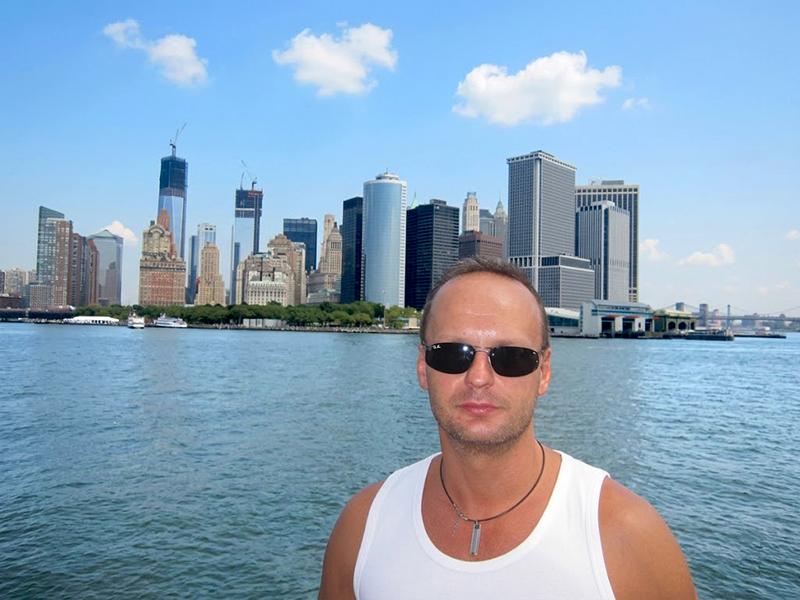
New York, 2012. A Hungarian boy who once dreamed of Manhattan from behind the Iron Curtain finally steps into the New World — decades late, and right on time.
· · ·
There is a particular kind of longing that belongs only to childhood — the kind that latches onto something so far beyond reach that it stops being a wish and becomes almost a religion. For me, that thing was New York City.
I was fourteen, living in communist Hungary in the 1980s, when I first heard 25 Este New Yorkban … — 25 Evenings in New York — by the Hungarian band Első Emelet. I played it on vinyl, the needle crackling into that opening chord, and something in me leaned toward the speaker as if I could hear the city itself through the sound. I had seen Manhattan in films, of course: those impossibly lit skylines, that density of life stacked a hundred floors high. But a film is a window. That song felt like a letter addressed to me.
New York, in those years, was not a destination. It was a mythology. For a boy on the eastern side of the Iron Curtain, America existed the way constellations exist — real, luminous, and completely unreachable.
Some places we travel to. Others we spend a lifetime traveling toward.
By 2012, the wall was long gone. But what finally pushed me onto that plane wasn’t freedom or opportunity — it was a crisis. My personal life had fractured badly that year, and I remember standing at the threshold of that decision the way you stand at the edge of cold water: knowing that the only way through is in. It would cost me several months’ salary. It didn’t matter. I bought the ticket. I went alone.
✦
The immigration queue at JFK is one of the great levelers. You shuffle forward in a long slow line — documents in hand, strangers on all sides, fluorescent lights humming overhead — and there is nothing to do but wait and think. Standing there, I found myself thinking about my grandmother’s siblings, who had made this same crossing in the 1920s. Not by plane, but by ship. Weeks at sea. They arrived with almost no money, no English, and no certainty of what waited for them. They stood in a different kind of queue — perhaps not so different in its silence, its weight, its mixture of fear and hope. I had a return ticket and a credit card. They had nothing but the nerve to keep moving. I thought about that for a long time, shuffling forward one small step at a time.
And then I was through. And I was in a transfer bus moving toward Manhattan.
I put in my earphones. Alicia Keys came on — Empire State of Mind. The timing was not planned. It simply happened, the way the best things do.
And then, through the bus window, the skyline appeared. The Manhattan Bridge. The towers. The impossible geometry of it, just sitting there in the late afternoon light like it had always been waiting.
I was a Hungarian boy who had once dreamed of the Big Apple from the wrong side of history, and now I was here, and the city had no idea, and it didn’t need to.
There are moments that do not translate into language cleanly — they arrive as a fullness in the chest, a stinging behind the eyes, something that is grief and gratitude at once. The child who had pressed his ear to a vinyl record in a small apartment in Hungary had carried this image for thirty years. And here it was. Not a film. Not a song. Real light on real water, and the bridge rising into it, and the city beyond.
I didn’t cry. I just looked. And looked. And let it be exactly what it was.
· · ·
Hello, America. I have arrived. New York First Arrival USA Memory Cold War Personal