The First Great Journey — Joining the Foreign Legion
Legio patria nostra.
The Legion is our homeland.I grew up on the wrong side of the Iron Curtain. Communist Hungary in the 1980s was a world of invisible walls — not only the physical kind, but ideological ones that shaped everything: where you could go, what you could dream, how far your imagination was permitted to travel. Western countries were accessible once every three years, and even then, each adult was officially allowed to exchange no more than fifty US dollars per year. On the black market you could find more, at twice the price — but with wages as meagre as ours, the mathematics of freedom were brutal. The Iron Curtain was not just barbed wire and watchtowers. It lived inside us, too.
My first crossing into the West came in 1988, when my parents took me for a single day to Vienna. I was a teenager. What I felt standing in those streets — the colour, the abundance, the sheer ordinariness of it all — was something I had no words for. It was like stepping into a film I had only ever watched through glass.
Then, in 1989, the Wall fell. And slowly, cautiously, the world opened.
I finished secondary school in 1992 — among the first generation in Hungary not required to sit a final exam in Russian. English, which I had studied only from middle school onward, felt like more than a language to me. It was a symbol. Hungarian is a beautiful tongue, but a solitary one — spoken by fewer than fifteen million people, untranslatable in its logic, it had always been one more invisible wall between us and the wider world. English was the key.
The Decision
In early 1993, I was nineteen years old and restless with something I could not name. I had been studying at a military academy for a period, which had given me a taste of discipline and structure — but what I craved was not structure. It was movement. Encounter. The feeling of being genuinely, irreversibly out of my depth.
In a book, I found the address of a barracks in Paris where one could apply to join the French Foreign Legion. The idea caught in me immediately, the way only the right ideas do. The Legion carried a particular mystique in Hungarian culture — the beloved writer Jenő Rejtő had woven it into several popular adventure novels, filling its ranks with colourful outcasts and honourable rogues. The image that formed in my mind was intoxicating: adventure, travel, work and a wage, all compressed into one wild decision.
I did not deliberate for long. I packed a rucksack, bought a plane ticket, and boarded my first ever flight. Three days later, I was in Paris.
I was nineteen, with a rucksack and a phonetically transcribed French sentence. That was all I needed. That was everything.
Fort de Nogent
Following the instructions in the book, I asked a policeman for directions — in English, since my French extended to exactly one word: oui. By early afternoon I was standing at the gate of Fort de Nogent, a Legion recruitment post on the eastern edge of the city. I had phonetically written out the phrase I needed and I read it, haltingly, to the severe-looking sergeant at the gate: Je m’engage pour la Légion…
The gate opened. The soldier, without ceremony, pushed me inside.
Within minutes my bag had been unpacked and inspected — they checked my arms for needle marks — and I was escorted to an office. Everything happened so fast that I had barely registered it when I found myself sitting down to dinner inside a French Foreign Legion barracks. The menu was lasagne. I had never eaten lasagne before. It was extraordinary.
Around the table sat a Portuguese, two Frenchmen, a Pole, a young man from Martinique, and a Yugoslav. We had no shared language. We had, somehow, a shared table. The feeling was difficult to describe — a mixture of mild anxiety, quiet pride, deep uncertainty, and the strange electric warmth of a dream in the process of becoming real.
Aubagne
After a week at the Paris post, we were loaded onto an overnight train to Marseille — to Aubagne, and the Legion’s 1st Foreign Regiment: its spiritual and administrative heart. On arrival, we were herded into a long room, ordered to strip, handed military duffel bags, and told to pack every item of our civilian clothing inside. The bags were labelled and removed. In their place: used boots, a uniform, soap, and access to a shower.
In the recruitment centre at Aubagne there were perhaps a hundred and fifty to two hundred men at any given time, waiting to be assessed, accepted, or turned away. Every day, ten men would be sent on. Every day, ten or twenty more would arrive. I waited there for three weeks.
There were other Hungarians. A policeman. A competitive athlete. A carpenter. Most had come for the adventure, or hoping for a better life; a few, it was quietly understood, were running from something. The same was true of the whole company — Brazilians, Germans, Japanese, Chinese, English, Poles, Russians. The world had sent its restless ones to this dusty courtyard in the south of France. In those years, if a man admitted he had come from behind the Iron Curtain, the response from some quarters was a dismissive pède rouge — red queer. That was Europe, just over three decades ago.
Castelnaudary — The Training
After three weeks, a platoon was assembled and transported by train — in a separate carriage, as though we were already something apart — to Castelnaudary, home of the Legion’s 4th Regiment and the site of all basic training.
The first month took place on a remote farm somewhere in the mountains. Only our platoon and our instructors. What followed was an education in extremity.
Each morning began with what they called an apéritif: pull-ups, push-ups, rope climbs, sit-ups, sprints — in various combinations, before breakfast. We ran carrying pine beams four to five metres long, weighing a hundred and fifty kilograms, shared between two men, for up to a kilometre at a stretch. We marched ten kilometres through rivers. We swam in lakes, fully dressed, in boots. We crawled through mud. We slept for a few hours each night, sometimes less — weeks passed in a fog of exhaustion so complete that sleep deprivation became its own form of altered consciousness.
Violence was routine. Most men were struck at least once a day — sometimes an open-handed slap, sometimes a fist, sometimes a boot or a baton. I was made an example of during a meal: the duty soldiers had cooked too much food, and waste was not permitted. I was force-fed until I vomited. A Czech recruit was stripped naked in the courtyard in winter and hosed down with freezing water while the rest of us watched, shivering in our clothes.
These are not things I recount for effect. They are simply what happened. And within that brutality, something strange also happened: I discovered the outer edge of what I was capable of.
The limits I had imagined for myself were fictions. The body endures far more than the mind believes possible. Almost everything, in the end, is decided in the mind.
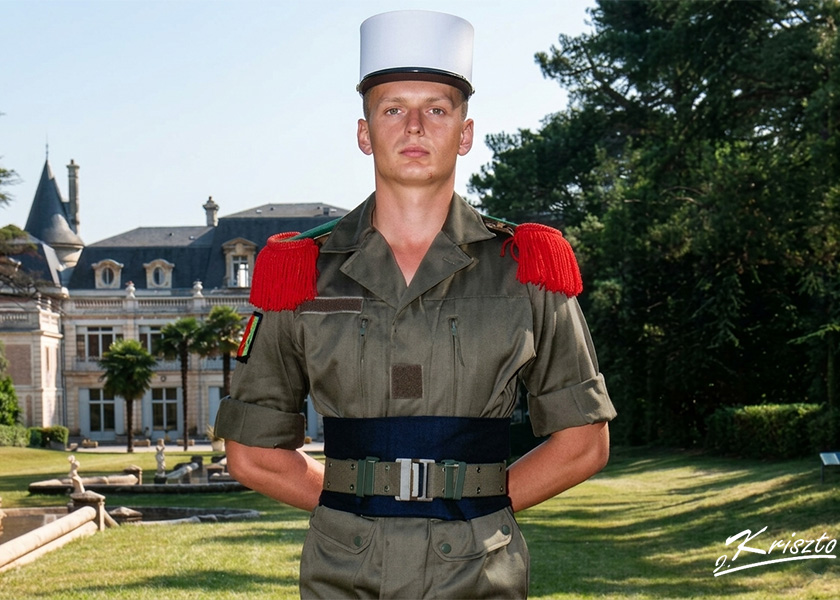
After two months on the farm, a two-day forced march served as the initiation rite. We received the white képi. We returned to the regimental barracks and training continued — sixteen weeks in total, easing only fractionally in the final fortnight. Of the thirty-five men who had begun together in our platoon, seventeen remained. Some had attempted suicide. Some had deserted. Others had suffered serious injury or cardiac episodes. Most who left had simply broken — quietly, privately — and found a medical pretext to be released.
The training concluded with written and physical examinations, and a final five-day march of roughly one hundred and seventy kilometres through the French Alps. This was the Marche Képi Blanc — the March of the White Képi. We finished it.
What Five Months Taught Me
That my limits were considerably further away than I had ever imagined — physically, mentally, and emotionally.
That endurance is less a physical condition than a decision made, and remade, every single hour.
That the body follows where the mind insists.
That shared hardship creates a form of trust that comfort never could.
That being stripped of everything — language, possessions, identity, sleep — reveals something underneath that cannot be taken.
The motto of the 4th Training Regiment has stayed with me since: Ne pas subir — do not submit. Never give in. And so has the sixth article of the Legion’s Code of Honour, which we learned to recite and which I have never forgotten:
Two sentences. They have accompanied me through everything that came after — every venture, every failure, every moment when stopping felt easier than continuing. Not as commands, but as a compass. A reminder of what a human being is capable of, when they decide, fully and without reservation, to keep going.
Part Two coming soon — life inside the Legion.