Some cities are destinations, Paris is a civilisation.
Some cities are destinations. Paris is a civilisation.
It was founded in the third century BCE by a Gallic tribe called the Parisii, on an island in the Seine — what we now know as the Île de la Cité. The settlement was called Lutetia. The world it was born into was already ancient and astonishing: Hellenism was flourishing across the Mediterranean, weaving together Greek and Egyptian thought into something new. Rome was beginning its long ascent. Buddhism was spreading across the Indian subcontinent under the reign of Emperor Ashoka, whose capital Pataliputra — in modern-day Bihar — was home to more than half a million souls. The world’s great cities at that moment were Pataliputra, Alexandria, Carthage, Seleucia on the Tigris, and Chang’an in China.
London did not yet exist. Where it would eventually stand, there was marshland. Most of modern Europe’s great capitals were still centuries away from their founding. And yet here, on a small island in a northern river, a settlement took root that would outlast empires, survive invasions, ignite revolutions, and reshape the world more than once.
Paris was not merely present at the making of the modern world. In many ways, Paris was the making of the modern world.
A City That Survived Everything
Julius Caesar’s legions conquered and burned Lutetia in 52 BCE. The city rebuilt. It did not receive its current name until the fourth century, when it was renamed after its founders. Under the Capetian dynasty, beginning in the tenth century, Paris became the seat of royal power and entered its first great flowering.
What followed was a history so dense with consequence that it reads less like a city’s biography than like a chronicle of the human condition itself:
- 885–886 Paris withstood a prolonged Viking siege — and held.
- 1572 The St. Bartholomew’s Day Massacre: thousands of Protestant Huguenots killed by Catholic forces in the city’s streets. A wound that took generations to heal.
- 1789 The French Revolution — born here, on these cobblestones — brought down feudalism and delivered to the world the foundational language of human rights, liberty, and equality before the law.
- 1804 Napoleon crowned himself Emperor in Notre-Dame. His wars were bloody and divisive, but the ideas he carried across Europe — the Civil Code, the central banking system, the modern lycée — remade the continent’s legal and civic foundations.
- 1853–1870 Baron Haussmann rebuilt Paris into the world’s first modern metropolis, introducing the boulevard system that virtually every subsequent city would imitate.
- 1871 The Paris Commune established, briefly and violently, the world’s first communist government — a template that would echo through the following century.
- 1940 Nazi occupation. Paris fell in June. Four years of shadow.
- 1944 Liberation — August, with the French Resistance fighting street by street. The city emerged scarred but intact, its spirit unbroken.
- 1968 Student uprisings shook the city and sent tremors across the Western world, giving rise to the feminist movement, environmentalism, and LGBTQ liberation as political forces. Their motto still echoes:
Each of these moments could have defined a city permanently — for better or worse. Paris absorbed them all. And from each one, it sent something outward into the world: an idea, a law, a movement, a way of thinking about what human beings owe one another.
The Spirit of the Place
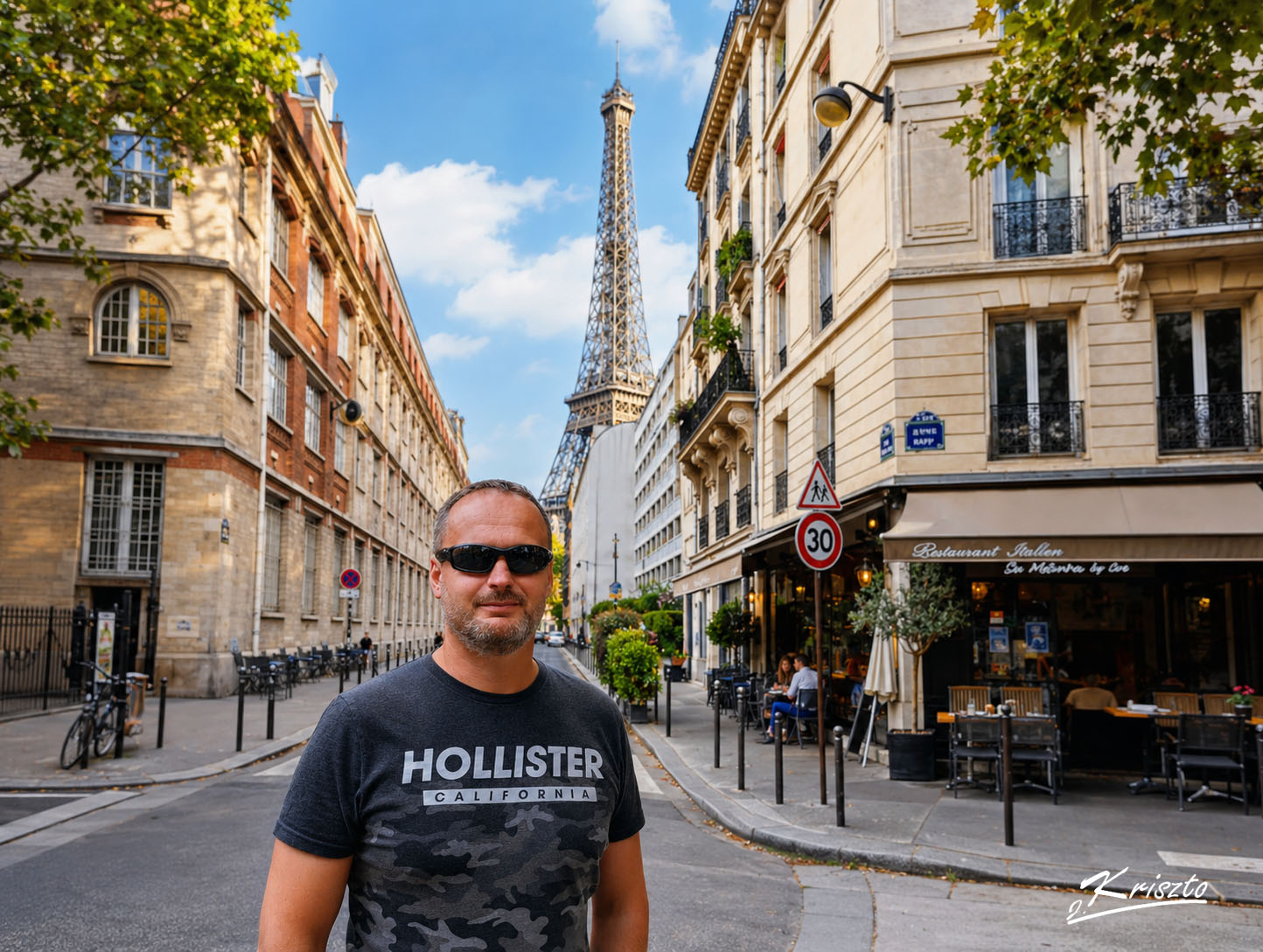
I have been to Paris many times, and what I feel there is consistent and difficult to explain to someone who hasn’t felt it. It is not the Eiffel Tower, though that too is worth your full attention. It is not the museums, though the Louvre alone could occupy a lifetime. It is something that seeps up from the ground and mingles in the air — a quality of the city’s relationship with its own history, and with the ideas it has carried and passed on.
Paris is not a city that wears its liberalism as a badge. It breathes it. The idea of freedom and equality is not an aspiration here — it is the sediment beneath the streets, laid down over centuries of argument, blood, and hard-won understanding.
In Paris, I do not feel Hungarian. I do not feel European. I feel, clearly and simply, human. Not more than anyone else, and not less — just one person among the many walking these streets, sitting at these café tables, carrying their particular history through this shared space. There are few cities on Earth where that feeling comes so easily or so completely. Paris is perhaps the finest argument I have encountered for the possibility of genuine cosmopolitanism — not as an abstract ideal, but as a lived, daily experience available to anyone willing to surrender their categories and simply be present.
The French elegance is real — not the cliché of fashion and gastronomy, though those too are genuine — but a deeper elegance: the elegance of a culture that has wrestled seriously with difficult questions for a very long time, and has arrived at certain convictions it is not prepared to abandon. Liberty. Equality. Fraternity. Three words that were forged here, paid for here, and have been defended here, imperfectly and stubbornly, across two and a half centuries.
A Prayer for the City
If I could ask something of Sainte Geneviève — the patron saint of Paris, who according to legend rallied the city against Attila’s Huns in the fifth century — it would be this: that Paris remain what it has always, at its best, been. A place of pilgrimage for those who believe in human equality. A city where that belief is not merely tolerated but expressed — in the architecture, in the café conversations, in the way strangers treat one another on the street.
Not a perfect city. Paris has never been that. But a city with a conscience. A city that takes seriously its role in the long story of what humanity might become.
If you visit Paris — and I hope you do — I want to offer you a way of seeing it that goes beyond the guidebook. As you walk through Montmartre’s winding streets, or lose yourself in the Latin Quarter’s bookshops and arguments, or stand before Notre-Dame and feel the weight of eight centuries pressing gently on your chest: remember that this city was already old when most of Europe was still forest. That the ideas which began here have circled the globe and returned, changed, again and again. That beneath the beauty and the history and the magnificent ordinariness of daily Parisian life, something continues — something that has to do with the oldest and most radical of human convictions: that we are equal. That we are free. That these things matter.
If you feel that — really feel it, walking these streets — then Paris will have given you something that will not fade when you leave. A city can do that, if it is old enough and has suffered enough and thought hard enough about what it all means.
Paris has. Paris does.
Let the city show you what it knows
about the past, the present, and what we might still become.
Paris is eternal. And so, perhaps, is the idea it carries.