Portugal — The Elegance of a Conquering Nation
There are countries you visit, and countries that receive you. Portugal belongs to the second kind.
This is one of Europe’s oldest and most distinguished nations, and history permeates it almost physically — not as a museum exhibit, not as something preserved behind glass, but as a living quality in the stones, the light, and above all, in the people themselves. What strikes me most about the Portuguese is not their architecture, remarkable as it is, nor their style of dress. It is something subtler and more difficult to name: a deep, unhurried elegance. An aristocratic stillness. The bearing of a people who have nothing left to prove to the world — because they already showed the world what they were capable of, centuries ago, and have been at peace with that knowledge ever since.
Before Spain had even begun its age of exploration, Portugal had become master of the seas. These were the true discoverers of the modern world — not merely in the sense of finding new coastlines, but in the deeper sense of connecting civilisations, reshaping trade, rewriting maps. After the signing of the Treaty of Tordesillas in 1494, half the known world fell under Portuguese economic and commercial dominion. Half the world. It is worth sitting with that for a moment.
The reach of that era has never fully receded. Portuguese remains the sixth most spoken language on Earth — carried by approximately two hundred and seventy million people across four continents, two hundred and thirty to two hundred and forty million of whom speak it as their mother tongue. It is an official language not only in Portugal and Brazil, but in five African nations — Angola, Mozambique, Cape Verde, Guinea-Bissau, São Tomé and Príncipe — as well as in East Timor and Macau, the latter of which remained Portuguese territory until 1999. A language is a civilisation’s longest shadow, and Portugal’s shadow falls across the globe.
The Atlantic Edge
Portugal shares its land border with only one country — Spain — and opens its western and southern edges entirely to the Atlantic Ocean. Nearly a thousand kilometres of oceanic coastline on the mainland alone; seventeen hundred if you include the islands. The Portuguese did not merely sail the ocean. They live alongside it, shaped by it, in a relationship of such long intimacy that the sea seems to have entered the national character itself.
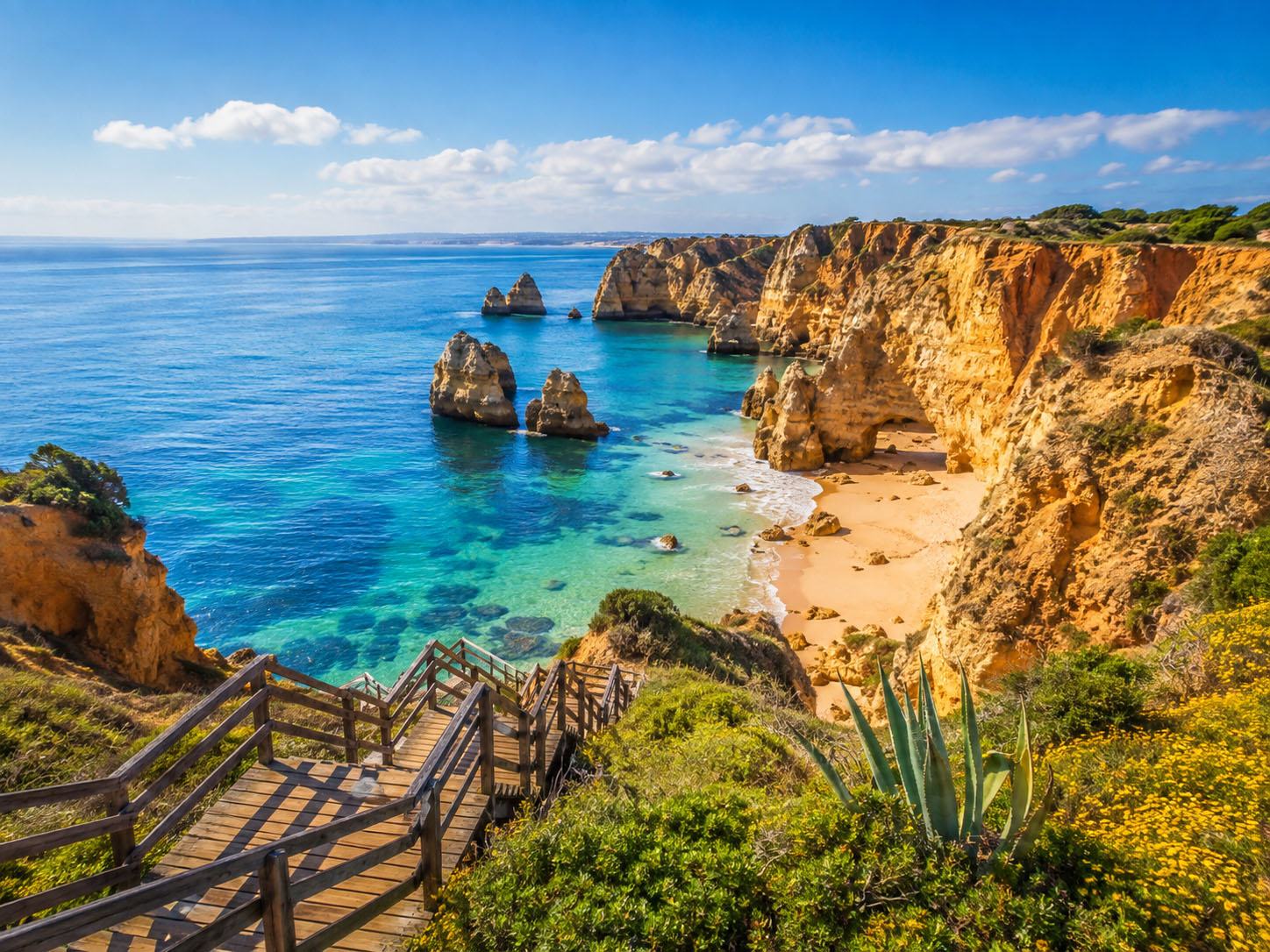
And what a coastline it is. The sheer cliffs of Sagres, dropping sixty to seventy metres into churning water. The extraordinary rock formations of Praia da Marinha near Carvoeiro. The sheltered golden arc of Praia Dona Ana at Lagos. The wild, surfer-beloved Mar Beach at Odeceixe. These are not merely beautiful beaches — they are geological theatre, each one distinct, each one carrying the particular mood of the Atlantic at that precise stretch of shore.
Along most of this coastline, parking is free and unhurried. It is entirely common — and entirely accepted — to anchor a campervan beside the ocean for days at a time, living within the rhythm of the waves.
Cities That Breathe
Lisbon and Porto are cities that move at their own pace — layered, luminous, unhurried. Sintra, perched in its wooded hills, belongs somewhere between fairy tale and hallucination: its palaces and castles accumulate Gothic, Moorish, Manueline, Indian, and eclectic influences in such extravagant combination that the result feels less like architecture than like the dream of architecture. Walking among them, you sense the weight of centuries of wealth and ambition and loss — all of it somehow rendered beautiful by time.
But the truest Portugal, in my experience, reveals itself in the smaller towns. In a coastal village where a single old man sits outside a café that has had the same owner for forty years. In the unhurried professionalism of a family restaurant where the cooking is serious and the welcome is genuine. Portugal has been receiving travellers, merchants, sailors, and wanderers for centuries — and that long practice of hospitality has become something innate, something the Portuguese carry not as a performance but as a natural disposition. Cultures have crossed and mingled here for so long that tolerance, too, has become a kind of inheritance.
Already Arrived
What Portugal gives me, more than anything else, is a particular quality of peace. Not the peace of emptiness or isolation, but the peace of a place that has found its own rhythm and sees no reason to abandon it. The Atlantic light. The ocean’s constant presence. The warmth of people who are friendly without being eager, gracious without being deferential — people who seem to have already arrived wherever they were going, long ago, and are now simply enjoying the view.
There is a Portuguese word — saudade — that has no clean equivalent in English. It describes a longing, a melancholy tenderness for something cherished and perhaps lost or distant. I think of it every time I leave. Because Portugal is one of those places that does not stay behind when you go. It travels with you, quietly, as a feeling you cannot quite name — and cannot quite shake.
They have already arrived.
And somehow, for a while, they make you feel that you have too.